
From Concept to Casting: OEM Jewelry Development
A concept drawing becomes a cast ring, pendant or earring through a short series of fixed gates, and the published timing for those gates is tight: 3D CAD under 48 hours, master sampling 25–30 days, bulk production 3–4 weeks. Added together, a full development cycle lands at 48–60 days, roughly seven to nine weeks. The casting itself takes minutes; the decisions around it consume the calendar.

Key takeaways
- CAD is published at under 48 hours, equal to 8% of a 25-day sampling window and 6.7% of a 30-day one.
- Master sampling at 25–30 days equals 3.6–4.3 weeks, longer than the 3–4 week bulk run that follows.
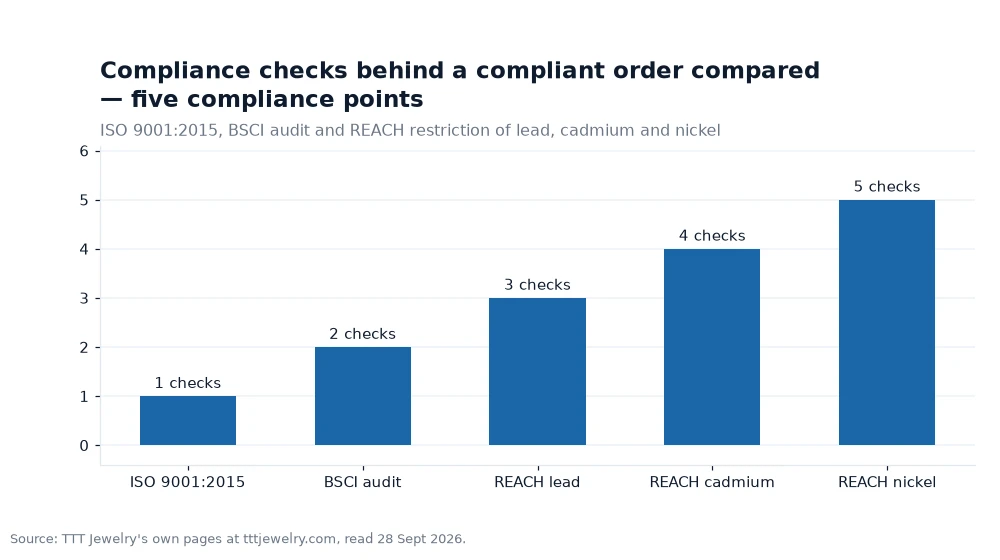
- Three certificates and two regulatory limits sit behind a compliant shipment: ISO 9001:2015, a BSCI audit, REACH, and CA Prop 65 for plating.
- Final inspection covers 100% of pieces, so rework is caught before packing rather than after arrival.
The chain in plain order
A cast piece starts as a drawing. The bench route runs from concept design, hand-drawn and then modelled in CAD, into prototyping by mould or by 3D printing. From there the tree is cast, sprues are cut, surfaces are polished to a high gloss, brushing and texture are applied, electroplating follows, and every piece passes inspection before it is packed. Eight steps, and only a few of them remove metal.
The order matters because each step constrains the next. A wall thickness chosen in CAD decides how metal flows into the mould. That flow decides where a sprue can be attached. Sprue position then decides which surfaces need polishing after cutting. A buyer who moves a stone seat late in the sequence does not edit one number; they reopen the master, the mould and the finish plan together.
Casting also introduces a variable that drawings hide: contraction. Metal shrinks as it cools, so the pattern is dimensioned slightly oversize and the mould is cut to compensate. The compensation is specific to the alloy and to the section thickness. This is why a supplier that casts silver, brass and stainless steel in the same building tends to quote different tooling allowances for the same drawing. It is also why an OEM/ODM programme usually fixes the material before the geometry: the metal decides the mould.
What locks at each gate
Development is easier to manage when every stage is treated as a gate with a named output. The table maps the published allowances to the decision that stops being cheap to reverse once the gate closes.
| Gate | Output | Published allowance | Decision locked |
|---|---|---|---|
| Inquiry and consultation | Written brief and material choice | 24-hour response | Metal family and target quantity |
| CAD and prototype | Editable 3D model | Under 48 hours | Dimensions, wall thickness, stone seats |
| Sample and approval | Wearable master | 25–30 days | Fit, clasp, surface and plating |
| Bulk production | Saleable units | 3–4 weeks | Plating thickness and packing |
| Final QC and delivery | Inspected goods | 100% inspected | Nothing; rework returns to the bench |
Two rows carry most of the risk. The CAD row is fast, under two days, but it is where buyer intent becomes geometry. The sampling row is slow, 25 to 30 days, and it is where geometry meets a real mould. A brief that is vague at the first gate usually reappears as a second sampling round at the third.
Why the cast tree, not the sketch, sets tolerance
On the bench, a rubber mould cut from an approved master and a directly printed pattern behave differently. The mould route suits repeat orders because the cavity is reusable and the shrinkage allowance is already baked in. The printed route suits geometry that cannot be pulled from a two-part mould, or a shape still under revision. Neither route is inherently finer; they fail in different ways.
After casting, the tree is cut. Every cut leaves a stub, and every stub is removed by hand or by abrasive. Polishing then takes a further layer of metal from high points, which is why a dimension measured on the raw casting is not the shipping dimension. Plating adds a few microns back. The sequence of subtraction and addition means tolerance has to be specified in a named state: as cast, after polish, or after plate.
This is the point where a buyer learns whether the supplier runs a bench or a trading desk. Ask at which step a dimension was measured, and in what condition. A jewelry OEM ODM partner that answers in process terms, naming cast, cut, polished and plated states, is describing work it performs itself.
Compliance work that runs in parallel
Certification is not a stage at the end of the schedule. ISO 9001:2015 covers quality management across all production stages, which in practice means inspection points are documented rather than improvised. A BSCI audit addresses labour and social conditions at the site. REACH compliance removes lead, cadmium and nickel from the material specification, and plating is stated as fully compliant with REACH and CA Prop 65.
Those checks matter at different moments. Alloy selection happens at the brief. Nickel release is decided by the plating stack. Cadmium can enter through solders and findings. Labour conditions sit outside the product entirely but are increasingly requested in supplier questionnaires from European retail buyers. Gathering the paperwork during sampling costs nothing extra; gathering it after production costs a shipment.
Volume buyers comparing quotations often find that a lower unit rate sits beside a thinner plating stack or an undocumented alloy. The custom jewelry wholesale route is not exempt from that arithmetic, and neither is the silver route. The paperwork is the same at any quantity.
Worked example
Take the allowances at face value and build a calendar. CAD takes under 48 hours, which is 2 days. Master sampling takes 25 to 30 days. Bulk production takes 3 to 4 weeks, which is 21 to 28 days. The total is 2 + 25 to 30 + 21 to 28 = 48 to 60 days, or roughly 7 to 9 weeks.
Now look at the shape of that total. The 2-day CAD step is 2/48 = 4.2% of the shortest cycle and 2/60 = 3.3% of the longest. Sampling and production together account for 46 to 58 of the 48 to 60 days. A buyer protecting a launch date should therefore press on sample approval, not on CAD turnaround. Compressing two days cannot rescue a schedule that loses a week at the sample gate.
One further ratio is worth holding. If a design needs two sampling rounds instead of one, the calendar gains another 25 to 30 days, pushing the total to 73 to 90 days. Approval discipline is cheaper than a second round, and a written approval checklist costs less than either.
Frequently asked questions
How long does OEM jewelry development take from CAD to delivery?
Published timings give 48 hours for 3D CAD, 25 to 30 days for master sampling and 3 to 4 weeks for bulk production, which adds up to 48 to 60 days.
Does a cast prototype match the final production piece?
The approved master sets fit, wall thickness and stone seats, and production moulds are grown from that master, so later changes restart sampling rather than editing a file.
Which compliance documents should accompany a cast order?
ISO 9001:2015 for process control, a BSCI audit for labour conditions, and REACH declarations covering lead, cadmium and nickel, with plating tested to CA Prop 65.
Reading a development schedule before you sign
Ask for the schedule in the units the factory uses: hours for CAD, days for sampling, weeks for production. Convert everything to days and the critical path becomes visible. Then ask which gate the supplier treats as fixed and which as elastic; the answer shows where slack really sits.
A schedule quoted as one total without gates is a promise rather than a plan. For lines that mix metals, it is worth pricing a brass programme beside the silver one, because the custom brass jewelry MOQ of 100 pieces per design is double the 50-piece silver threshold and changes how tooling is amortised.
Finally, read the NDA and the tooling clause before the first drawing leaves your desk. Those two documents decide what happens in year three, when the collection has a history and the mould has a value no one discussed at the start.
Source note: figures come from the manufacturer's own website (tttjewelry.com), read 28 Sept 2026.[1]